Showing posts with label Cookbooks. Show all posts

Monday, June 1, 2009

Book Reading Tonight - Lisa M. Hamilton


Tonight at Powell's City of Books, downtown on Burnside, Lisa Hamilton will be reading from her new book "Deeply Rooted: Unconventional Farmers in the Age of Agribusiness".
7:00 pm
Free
This event is co-sponsored by Edible Portland.

Lisa Hamilton is a photographer and journalist who focuses on agriculture and sustainable food systems, with s special focus on farmers. A century of industrialization has left our food system riddled with problems, yet for solutions we look to nutritionists and government agencies, scientists and chefs. Lisa M. Hamilton asks: Why not look to the people who grow our food?


Hamilton makes this vital inquiry through the stories of three unconventional farmers: an African American dairyman in Texas who plays David to the Goliath of agribusiness corporations; a tenth-generation rancher in New Mexico struggling to restore agriculture as a pillar of his crumbling community; and a modern pioneer family in North Dakota who is breeding new varieties of plants to face the future's double threat: Monsanto and global warming.

Why, she asks, has it taken so long to go straight to the source? Join me at Powells tonight to hear her answers.

Sounds great - hope to see you there!

Photos © Lisa M. Hamilton

Thursday, April 9, 2009

Top 10 Best Books on Conscious Eating


My library routine is pretty, well, routine. I return the books I've finished, pick up the books I've put on hold, and make a beeline for the cookbooks and cooking section. It's not large, maybe ten shelves, but this section never fails to supply me with a few choice picks. Over the years, as I've become passionate about what I call "SOLE" Food - choosing ingredients that are Seasonal, Organic, Local, and Ethical - I've been inspired and informed by some amazing authors. I find myself recommending these books over an over to my friends, family, and strangers in the produce section.


Here are my top ten favorite books about the food we eat, the passionate people who grow it, and how our choices effect our bodies, our communities, and the world.

1. Animal, Vegetable, Miracle by Barbara Kingsolver
This book is my hands-down favorite on the subject. Many of you will recognize Kingsolver's name from her classic novels like the Poisonwood Bible and the Bean Trees, and this book is a beautiful little gem of storytelling, memoir, food politics, family, and a lot of good food!

2 Full Moon Feast: Food and the Hunger for Connection by Jessica Prentice (Chelsea Green)

3 The Food Revolution: How Your Diet Can Help Save Your Life and Our World
by John Robbins (Conari Press)

4. Omnivore’s Dilemma by Michael Pollan - Many know Michael Pollan as the spokesman of the modern food-awareness revolution. This is my favorite of his books because of it's people-oriented approach.

5. Hope's Edge: The Next Diet for a Small Planet
by Frances Moore Lappe and Anna Lappé

6. Food Matters: A Guide to Conscious Eating with More Than 75 Recipes
by Mark Bittman

7. How to Pick a Peach: The Search for Flavor from Farm to Table
by Russ Parsons

8. Plenty: One Man, One Woman, and a Raucous Year of Eating Locally by Alisa Smith and J.B. MacKinnon (Crown Publishing)

9. The Revolution will not be Microwaved: Inside America's Underground Food Movements by Sandor Ellix Katz

10. Slow Food Nation: Why Our Food Should Be Good, Clean, And Fair by Carlo Petrini

* Regional Bonus: Portland's Bounty: A guide to Eating Locally and Seasonally in the Greater Portland and Vancouver Areas by Ecumenical Ministries of Oregon's Interfaith Network for Earth Concerns; 2nd edition (2001) - Available through the Multnomah County Library

These books are full of inspirational ideas, facts, recipes, and stories about the people who realize that food is the key. Have you read these books? What did you think? What are your favorites?

Eat, and Read, Well!

Monday, December 1, 2008

Sweet Potato Ginger-Stick Curry


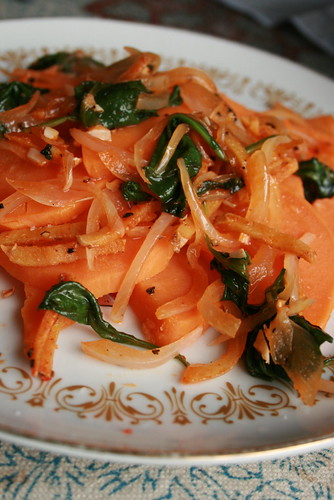
Leave it to Lynne Rossetto Kasper to figure out what my stir-fries have been missing. I've been cooking my way through The Splendid Table's new cookbook, How to Eat Supper, and there has been no shortage of epiphanies and inspiration. I'm always looking for more things to do with sweet potatoes (she calls them yams) because I find myself buying more every time I go to the store. They are just so comforting, healthy, and they last forever. Sweet potato fries are a regular event at my house, but they never seem to fully explore the potential of the ingredient.

In this recipe, the fantastic Lynne treats the humble sweet potato the way it should be treated - with tons of flavor and complexity. Don't get me wrong, I find myself dreaming of a simple baked potato with butter and brown sugar a bit more than I'd like to admit, but all too often the tuber is tossed to the side. Here, it's the star.


She calls it a curry, which I suppose it might be and I'm just not up on the full range of uses of the word, but the strongest flavors are ginger, jalepeño, basil, and lime. Yum. The key here is the ginger - the recipe calls for ginger "peeled and sliced into paper-thin matchsticks". Luckily, I have a good knife, but I see how it might be a challenge.

Lynne says:
Cutting the ginger into paper-thin matchsticks may seem fussy, but there is method to what seems to be madness. That shape changes how you taste the ginger in this dish. Crushed or chopped ginger would taste different - an interesting thing to remember when you see very specific instructions like these in Chinese recipes. There's always a reason.
I made this dish twice, once as a simple stir fry and another to make lettuce wraps, where I pared it with fresh sliced cucumber, cashews, and yogurt in fresh butter lettuce leaves. Sadly, the book is due back to the library today, and the hold list is miles long, so I can't renew. My birthday's tomorrow, maybe I'll get my own copy. Hint hint.


Eat well!
Sweet Yams in Ginger-Stick Curry

Yams
4 quarts salted water
2 large Garnet or Jewel yams (about 1 3/4 pounds), peeled, halved lengthwise, and cut into 1/4-inch-thick half-rounds.

Curry
Extra Virgin Olive Oil
One 1 inch piece fresh ginger, peeled and sliced into paper-thin matchsticks
4 large garlic cloves, sliced paper thin
1 jalepeño, sliced very thin
2 whole scallions, cut into 1-inch lengths
2 large shallots, sliced thin
Salt and Pepper
1/2 light-packed cup fresh basil leaves, course chopped
Juice of 1 lime

1. Bring water to boil.
2. Once water is bubbling fiercely, drop in the yams and cook them at a hard bubble for 10 minutes, or until tender. Drain in a colander and turn into a serving dish. Set the pot back on the stove.
3. Generously film the pot with oil. Set it over medium-high heat and add the ginger, garlic, jalepeño, scallions, shallots, and generous sprinklings of salt and pepper. Saute for two minutes, stirring often. Then cover the pot tightly, reduce the heat to medium low, and cook for 5-8 minutes, or until the ginger has softened.
4. Stir in the basil and cook, uncovered, for no more than 30 seconds. Spoon curry over yams, and squeeze lime juice over the finished dish.

Thursday, August 7, 2008

By Request: Whole-wheat Lemonbasil Bread


A few weeks ago, Angie from Three Sisters Organic Farm and Are We There Yet? asked me if I had a recipe for lemon basil bread that I could share. At the time I didn't, but I've been known to rise to the occasion for a food request (ah, that angel food "castle cake" - tip: don't try to frost an angel food cake. Really, try to avoid it. Especially at midnight the night before a nine year old's birthday party).

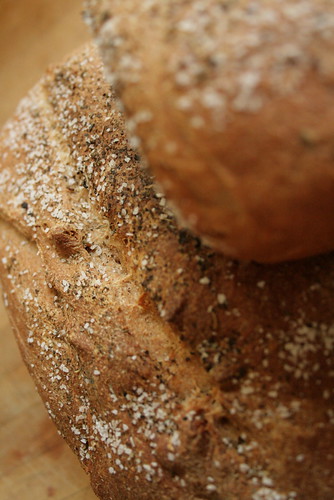
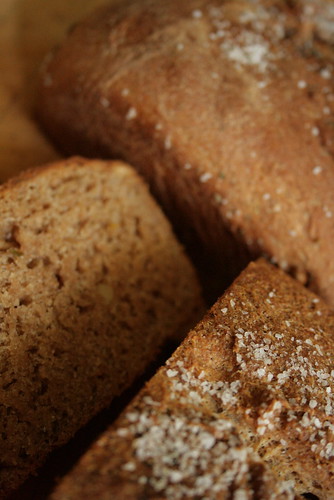
Part of my insistence on following through with Bread Tuesday on one of the hottest days of the year was experimenting with a bread recipe for Angie, adapted from the amazing Beth Hensperger's Bread Bible. I only have one cookbook dedicated exclusively to bread baking, but, at this point, it has served me well enough to keep it that way. I used her recipe for Basil Bread, and substituted lemon basil and pine nuts (which are optional, but give a great buttery nut crunch), as well as a good amount of lemon zest. The result was a hearty, flavorful, savory bread... so good... hey, will you wait a second while I go grab some right now? Thanks.

...

Ok, I'm back. (note: this bread really wants to be toasted and dressed in salted butter. I only have unsalted at the moment, and the first bite was a bit uninspiring. Sprinkled a bit of sea salt and WHAM, there's the lemon basil flavor and pine nutty goodness. So salt it, friends.)


Aw, a dough heart.

This dough requires a bit of kneading, and mine was on the sticky side. One of these days I'm going to have to cowboy up and buy a stand mixer. The amount of time I spend whisking and kneading everything by hand really adds up. Anybody have an old one you're not using? I'll be happy to take it off your hands.

Enjoy this bread, it would go really well with a tomato based pasta sauce - basil, tomato, and pine nuts... a holy trinity indeed.

Eat well, and stay cool!


Whole-Wheat Lemon Basil Bread
Adapted from Beth Hensperger's The Bread Bible

Makes two 9-by-5 loaves

1/2 cup warm water (105° to 115°F)
1 tablespoon (1 package) active dry yeast
Pinch of sugar

1 cup warm buttermilk (105° to 115°F)
1 cup warm water (105°to 115°F)
1/4 cup honey
4 tablespoons unsalted butter, melted
5 to 5-1/2 cups whole-wheat flour
1/2 cup minced fresh lemon basiI
1/2 cup pine nuts, chopped
2 tablespoons lemon zest
2-1/2 teaspoons salt

2 tablespoons olive oil
1 teaspoon sea salt
1 tablespoon dried basil

1. Pour the warm water in a small bowl. Sprinkle the yeast and sugar over the surface of the water. Stir to dissolve and let stand at room temperature until foamy, about 10 minutes.
2. In a large bowl using a whisk, combine the buttermilk and water. Stir in the honey and melted butter. Place 2 cups flour, the basil, zest, nuts, and salt in a large bowl. Add the milk and the yeast mixtures and beat until smooth, about 3 minutes. Add the flour, 1/2 cup at a time, with a wooden spoon until a soft dough that just clears the sides of the bowl is formed.
3. Turn the dough out onto a lightly floured work surface and knead until soft, slightly sticky, and very pliable, about 5 minutes, dusting with the flour only 1 tablespoon at a time as needed.
4. Put the dough in a greased deep bowl. Turn the dough once to grease the top and cover with plastic wrap. Let rise at room temperature until doubled in bulk, 1 to 1-1/2 hours. Don't let this dough rise more than double in volume. Gently deflate the dough and let it rise again, if you have time. It will take only half the time to rise the second time.
5. Gently deflate the dough. Turn the dough out onto a lightly floured work surface. Grease two 9-by-5-inch loaf pans. Divide the dough into 2 equal portions. Shape each portion into a loaf and put in the pans. Cover loosely with plastic wrap and let rise again until doubled in bulk, about 30 minutes.
6. Brush the loaves with the olive oil and sprinkle them with salt and dried basil.
7. Twenty minutes before baking preheat the oven to 350°F. Place the pans on the rack in the center of the oven and bake 50 to 60 minutes, or until the loaves are brown and sound hollow when tapped with your finger. Transfer the loaves immediately to a cooling rack. Cool completely before slicing.

Tuesday, August 5, 2008

A Family Affair on Bread Tuesday


I woke up early this morning and declared it Bread Tuesday. I thought I'd better get to work using up the HUNDRED pounds of flour I bought this week, and set aside a few hours to make a lot of whole wheat bread - some to eat, some to freeze for later, some to bribe my loved ones with...

After a lovely morning of crossword puzzles, eggs benedict, and a whirlwind of spontaneous laundry sorting, I tied on my apron, turned on the radio, and got to work. Only one problem - the kitchen was a disaster zone. I live with my best friends, and none of us are especially messy individuals, but with the combined kitchen clutter output of my thrice daily cooking adventures and the sheer volume of kitchen usage between the five of us - it's bound to get pretty hectic. Oh, and how.

Luckily, I had my productive pants on and I happily got to work scrubbing, rinsing, drying, organizing, and sweeping up the accumulated kitchen lives of five twenty-somethings. I don't know when I became one of those people that loves doing dishes, but surely enough, I geek out over steel wool and soap bubbles. I was just about to settle into scraping the gunk from around the electric stove burners, when I realized I was having too much fun and it was time to get to work. Leaving the less-than-perfect stove top, I pulled out the big canister of whole wheat flour from the cupboard, snatched the yeast from the freezer, and was just about the heat some water to between 105 and 115 degrees, when I noticed something looking at me.
There, on the counter next to the garlic, were five brown, spotty bananas. My roommate Dragonfruit has this habit of buying weekly dollar bags of dozens of bananas from Limbo, and uses them as her primary source of nutrition until they run out. The promise of making banana bread with the mushiest of them floats in and out of actualization, but most of the time they disappear one by one as D gets hungry, their sad, brown peels lying in the compost next to the beet greens. Setting my yeast back in the freezer for a few more hours, I decide to make the dream a reality - it was Bread Tuesday after all - and banana bread there would be.
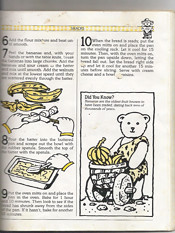
Here's where the family bit comes in. Growing up, my family used cookbooks even less than I do now - we had a series of truly reliable dishes in a relatively constant rotation, and if it was anything other than baked chicken thighs or spaghetti, my parents didn't need a recipe to whip up something new. The Joy of Cooking came out once in a while for cookies or cakes, but for the most part, we got along fine without help. Because of this, the few cookbooks we owned sat in the dining room closet dubbed the Liquor Cabinet - a full-sized shelved closet filled with homeopathic remedies, a bunch of random serving platters, the ice bucket for parties, and the same twelve bottles of liquor we only used when my grandparents came over. On the highest shelf of this random collection sat the cookbooks, lined up and gathering dust - save for the previously mentioned Joy and one other: My First Cookbook by Rena Coyle.

This was officially my older sister Casey's cookbook, and we would use it for after school snacks and the occasional breakfast in bed we'd make for our parents birthdays, anniversaries, sick days and such. Casey still waxes poetic about a certain recipe we made, spending an entire afternoon assembling a fancy chicken dinner of chicken thighs, canned cream soup, frozen mixed vegetables, and tubed biscuit dough (the tops of the biscuits would get all brown and the bottoms would stay gooey and doughy - which was a delight, believe it or not).

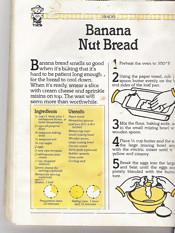
I'm pretty sure the only reason we even talk this book anymore is a certain Banana Nut Bread recipe. A few years ago, Casey wanted to make something special for her then-boyfriend, and remembered the famously moist banana bread recipe from the "teddy bear" cookbook, still at our parents' house on the top shelf. She called up Mom and Dad and asked them for the recipe, and the perfect banana bread was born again in New York. I emailed Casey this morning and asked her to send me the recipe, thinking she'd just send back a few paragraphs of text, but nope - I opened my email and found scanned images of the two pages from the original book, teddy bear illustrations and all.

She's not seeing that guy anymore, but you bet your buttons those scanned pages are still with here everywhere - literally - she's still got them on her iPod Touch. We'd made a batch a few weeks ago when I was down in California, and I thought I'd play with the recipe using a few of D's spotty bananas, lest they keep staring and distracting me from making the most of Bread Tuesday.

As I'm mixing up the bread - which gets its amazing tenderness from sour cream - I get two emails from Casey and my mom, simultaneously. Casey's says,
"Subject: my first cookbook
its called my first cookbook by rena coyle. mom says the page is covered in flour, banana and dough"
and Mom's reads,
"Subject: I just smelled the bear recipe of banana bread...
It does smell, even tastes like banana bread. Bob tasted some of the crumbs of dough on the page. Will be looking for the blog about it."

This is my family. Spread across the country, but united by the internet and a recipe. Three separate kitchens, in three corners of the nation, will smell like banana bread today. You should join us, and have a fantastic Bread Tuesday.

Eat Well.
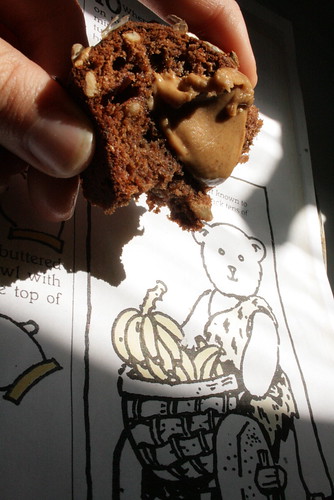

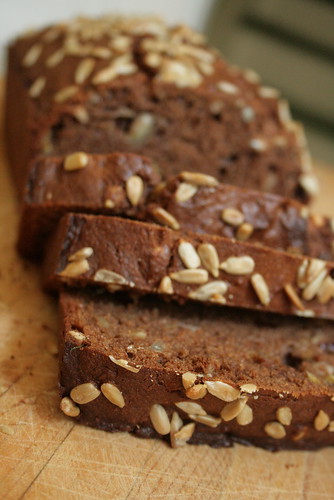
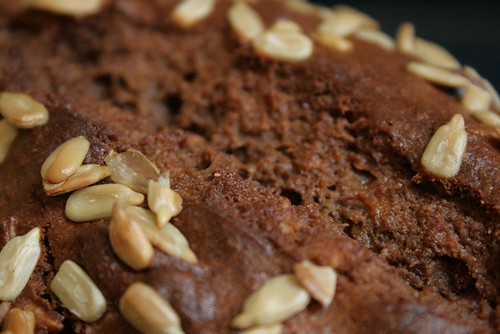
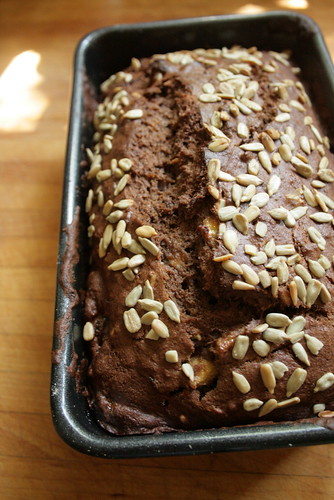
It doesn't surprise me that my dad tasted dough that has been smooshed between the pages of a children's cookbook for what must have been years, but you will be surprised by how good this banana bread is. As much as this story is about the original Banana Nut Bread, I just had to tweak it a bit. I'm me, afterall. I used 100% whole wheat flour, a bit of cocoa, some dried cranberries, and replaced the walnuts with sunflower seeds. Here's the recipe for my version of the Perfect Banana Bread.

Seedy Cocoa-Cranberry Banana Bread
adapted from Rena Coyle's My First Cookbook, 1985

1/2 cup butter plus 1 Tbs for greasing pan
2 cups whole wheat flour
3 Tbs unsweetened cocoa
3/4 tsp baking soda
1/2 tsp salt
3/4 cup sugar
2 eggs
3 very ripe bananas
2 Tbs sour cream
1/2 cup dried cranberries
1/2 cup raw, shelled sunflower seeds

Preheat oven to 350. Grease a loaf pan with butter. Mix flour, cocoa, baking soda, and salt in a small bowl. Cream together butter and sugar with hand mixer until creamy. Add eggs and beat until incorporated. Add cocoa/flour mixture and beat until smooth. USING YOUR HANDS, mush bananas into batter, leaving some large chunks. Add sour cream, seeds, and cranberries and mix until evenly distributed. Pour batter into loaf pan, scraping bowl with a rubber spatula. Bake for one hour and 10 minutes, or until the bread pulls away from the sides of the pan. Let cool, slice, and enjoy with family.

Save a few crumbs for future memories.

Thursday, July 31, 2008

Eating Up Free Books


NPR's All Things Considered featured a story yesterday about the boom libraries are experiencing this year - presumably due to the glummy economy. People are buying less new books, ending newspaper and magazine subscriptions, renting less movies, and instead are using the free services at the library. Kids programs are more successful than ever, computer use is at an all-time high, and, in this weather, you can't blame the people who stumble in to appreciate the free air-conditioning.

I'm all for the Public Library. My older sister and I were "Volunteens" at our local branch - my little sister is still putting in the hours - spending our summers making posters, cutting out bookmarks, and assembling pro-literacy buttons with a fancy button maker. Our librarians were our mentors, our honorary aunts, and we still get big hugs and surprised exclamations about how much we've grown. The murals in the downstairs children's section of my childhood library celebrating the citrus heritage of my hometown will always stick with me, even though they disappeared when the old building was completely renovated a few years ago.

Library appreciation is in my blood, but I have to admit I've always had a thing for bookstores - most of my high school years were spent sprawled in "my chair" at the local Barnes & Nobel, reading everything from art books to AP US History guides - and Portland has her share of the best spots for bibliophiles. Bookstores, I once argued, were far superior to the Libraries with their antiquated Dewey Decimal system. In a bookstore, I know where the cookbook section is because it's labeled COOKBOOKS, not because it's in the aisle between numbers 581.302 and 864.001. And I am inexplicably drawn to that new book smell. The truth is, however, a trip to Powell's can be quite a shock to my wallet, as I find myself tempted to pull everything off the shelves, all those shiny, colorful colors, the employee picks on the shelves, all the new releases of my favorite authors... It's not unheard of for me to throw down fifty bucks on "sale" books on a whim. As a college student on a budget, this adds up, let me tell you.

NPR hit it right on the nose - libraries are wonderful, and even better, they are free. Multnomah County has a great library system, which is, interestingly, the oldest library system west of the Mississippi! For the past few months, I've been making weekly stops at my local branch, and while I still spend a good amount of time at Fresh Pot, the coffee shop connected to the Powell's on Hawthorne, leafing through food magazines and journals, I think I've reclaiming my love for the library.

Today I went crazy in the food section - pulling out anything and everything that looked interesting - and walked out with a stack of great books. I'll be gobbling up:

The Real Food Revival: Aisle By Aisle, Morsel by Morsel by Sherry Brookes Vinton and Ann Clark Esuelas
In the Devil's Garden: A Sinful History of Forbidden Food
by Stewart Lee Allen
Extreme Cuisine: The Weird & Wonderful Foods that People Eat by Jerry Hopkins, Anthony Bourdain (my celebrity crush), and Michael Freeman
Plenty: One Man, One Woman, and a Raucous Year of Eating Locally
by Alisa Smith and J.B. Mackinnon
Fork It Over: The Intrepid Adventures of a Professional Eater by Alan Richman


I'll let you in on any great facts or stories I find. As I walked out of the library today, aside from being freed of the guilt that hits me after a "bookstore binge", I was struck with how sustainable the Public Library system is. I know this is a bit obvious, but it makes so much sense that I should borrow shared books instead of buying new ones. I can still get that great smell from the New Books section, and I know that I'm not adding more waste to the system. Now, if only they'd get rid of that silly decimal system...

I'm off to cuddle up with a good book and some lunch. Got a Library Card? Go use it, and let me know if you find any great books to eat read!

Eat, and Read, Well.

This is also a submission to Joelen's Culinary Adventures Tools and Cookbooks challenge. She rocks!

Saturday, July 26, 2008

Weekend Cookbook Challenge #30: Farmer's Markets


I had to laugh a little when I saw the theme the wonderful (and fellow Portlander!) Michelle of Je Mange la Ville picked for July's Weekend Cookbook Challenge: Farmer's Markets! I don't think I'm going to shock anyone with the fact that I spent all day at the Portland Farmer's Market at the PSU campus, and had plenty of options for my submission.

I chose a recipe from the fabulous Blue Eggs and Yellow Tomatoes: Recipes from a Modern Kitchen Garden by Jeanne Kelley. Ivonne over at Cream Puffs in Venice has praised this book, calling it "one of the most beautiful cookbooks [she has] ever seen!" so, of course, I had to get a copy. I wanted something that would really highlight a single, beautiful seasonal ingredient, because that's what the farmer's market is all about - getting the best of the best when it's at its peak.

I picked up some stunning carrots at Groundworks Organics' booth this morning, as well as some local shallots and (amazing) goat cheese. The recipe, which I tweaked just a bit to feature my local ingredients, was originally a sweet carrot soup with a dill gremolata. I substitued lemon basil for the dill (for obvious reasons), left out the orange zest (sadly, no orange trees in Portland), and added a swirl of local cream, goat cheese crumbles, and capers.

A deceptively simple recipe, the few ingredients worked so well together, it's easily one of the best soups I've made. I especially loved the salty capers and goat cheese paired with the sweet carrot that is the star of this dish. I can't recommend this enough. It took no more than 35 minutes, almost all of that downtime waiting for the carrots to cook, and cost next to nothing. A bonus, the soup itself is really low-calorie, being made of only carrots, shallots, a bay leaf, and water! Which, of course, I negated with my liberal use of cream and goat cheese. It's so worth it, friends. Trust me.

Happy weekend, and remember... Eat Well.

Sweet Carrot Soup with Basil, Goat Cheese, and Capers
Adapted from Leanne Kelley's Blue Eggs and Yellow Tomatoes
(serves 4 to 6)

For Soup
3 tbs unsalted butter
2 large shallots, sliced
2 pounds fresh, organic carrots, sliced into rounds
4 cups water
2 bay leaves
1/2 tsp sea salt

For Topping
2 tbs minced shallot
1 tbs minced fresh basil
3 tbs whipping cream
2 tbs capers
1/2 cup crumbled goat cheese

Melt butter in a large saucepan over medium heat. Add shallots and saute until tender and golden brown. Add sliced carrots, stir to coat with butter. Add 4 cups water and the bay leaves, and bring to a boil. Reduce to a simmer, and cover for 20 minutes, or until carrots are very tender. Remove the bay leaves, and puree soup with an immersion or standard
blender. Season with salt to taste. Divide into bowls and garnish with herbs, minced shallot, cream, goat cheese, and capers. Enjoy!

Thursday, July 24, 2008

Back to the Classics


True confessions: The ratio of cookbooks I have to cookbooks I use is... shall we say... embarrassing. I buy them compulsively, drawn to beautiful covers, exotic cuisines, lofty dreams of a new, sustainable hobby (someday I'll bake my own bread weekly... Until then Beth Hensperger's Bread Bible will be damn good bedtime reading).


It's not that I don't love my cookbooks, it's just that, as a college student on a budget, meals have been a bit, ahem, improvisational. Gotta have my grains and beans, then it's whatever I picked up at the farmer's market. Given how gorgeous and fresh the produce is in Portland, I rarely feel like doctoring it up with heavy sauces or complicated dressings. A bit of sea salt, if anything, does the job quite fine.

Today, however, I sidled up to my cookbookcase, in search of something very specific.

This morning I was greeted by my roommate, Dragonfruit, with what amounts to earth shattering news around these parts. Limbo, the produce market across the street from our house, just put out ONE DOLLAR CHERRY BOXES. Limbo dollar bags are truly hit or miss. D has been making a lot of banana bread lately from the huge bags of ripe 'nanas, and I look forward to late summer when bruised tomatoes will make great pasta sauce. But... Cherries. Big, dark, ripe local cherries. It's enough to make my little lemonbasil heart pound with joy.


Usually, I'd gobble up the little jewels on the spot, but we bought so many that I thought I'd make something special.

Here's where the cookbookcase comes in. I started pulling out the regular suspects, only to find that fresh cherries are not the stone fruit of choice for my favorite modern writers. Most of them used dried cherries, which are a completely different animal. After exhausting the indexes of my favorite books, I doubtfully looked to the classic section. Stacked together on the very top shelf, a series of well-worn, fading hardbacks. I keep them around for the history, dreaming of someday researching early-to-mid-century culinary anthropology, but I rarely think of actually using them.

After today, that might change. The winner was Ruth Berolzheimer's The United States Regional Cookbook from 1947. I adapted the recipe for Rolled Cherry Upside-Down Cake, supposedly native to the Mississippi Valley. A great little book, the Regional Cookbook did not let me down. It did, however, make me fantasize about a plausibly embellished past, in which regional, seasonal eating made the most of a bounty like my Oregon cherries, and cookbooks allowed young women like myself to savor the gifts of our immediate surroundings.


Here's to local finds, summer desserts, and returning to the classics.

Eat well.


Fresh Cherry Upside-Down Cake
Adapted from Ruth Berolzheimer's The United States Regional Cookbook
The original recipe called for a jelly-roll presentation, but I didn't want to hide the cherries, so I used a 9-inch round cake pan.

Fruit Mixture:
1/4 cup butter
3 cups fresh pitted cherries
1 cup sugar
1 tbs flour

Cake Batter:

4 eggs, separated
3/4 cup sugar
3/4 cup unbleached, organic flour
1/2 tsp vanilla
1/8 tsp salt

Preheat oven to 350. Melt butter in saucepan over low heat with half the sugar. Pour mixture into cake pan and cover with cherries mixed with remaining sugar and flour. Set in oven to heat while preparing batter. Mix together flour and sugar. Beat egg whites stiff and carefully fold in flour mixture. Add vanilla and slightly beaten egg yolks. Spread batter over hot cherries and bake for 30-40 minutes, or until cake springs back when gently pressed. Let cool and transfer, upside down to a plate.